

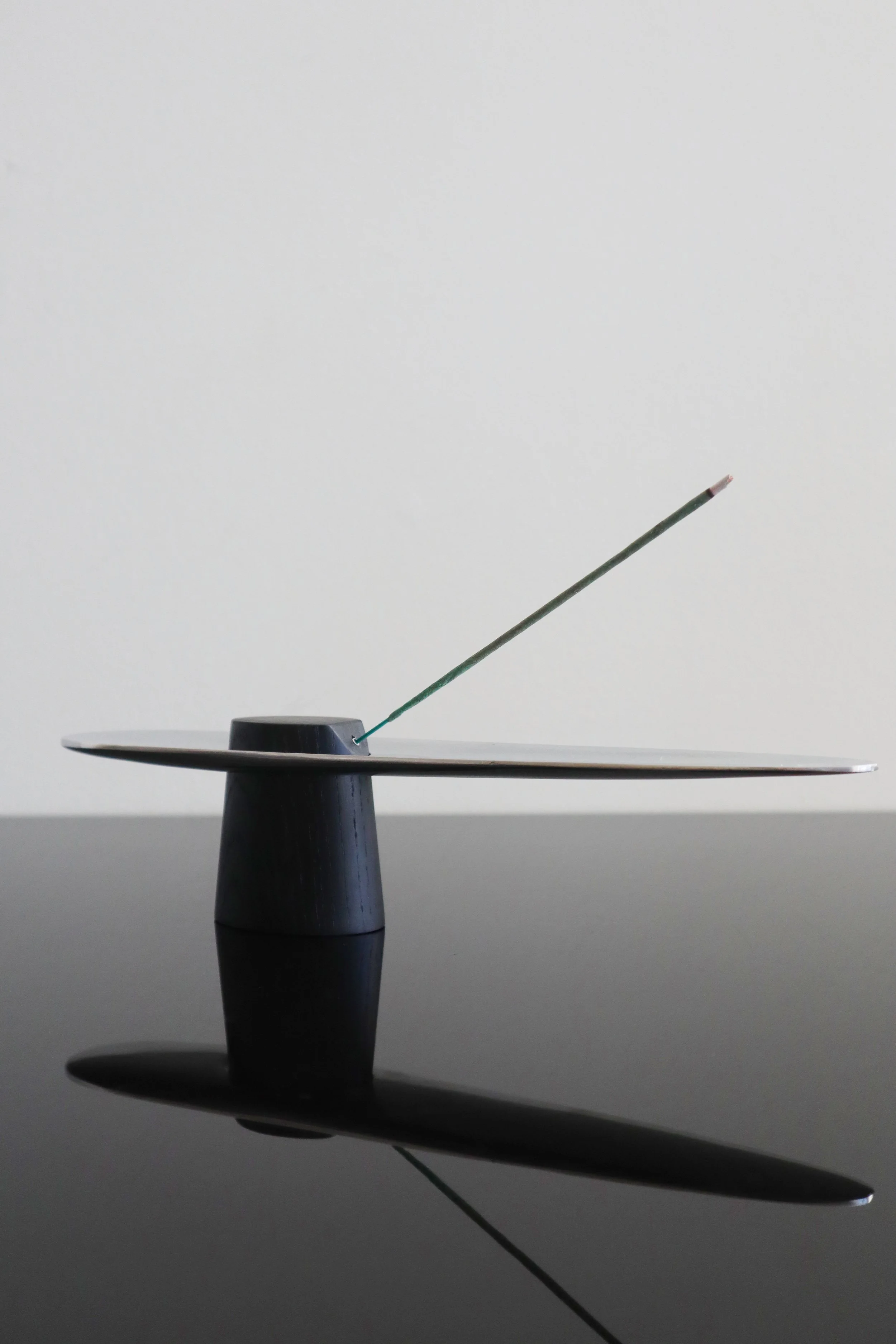
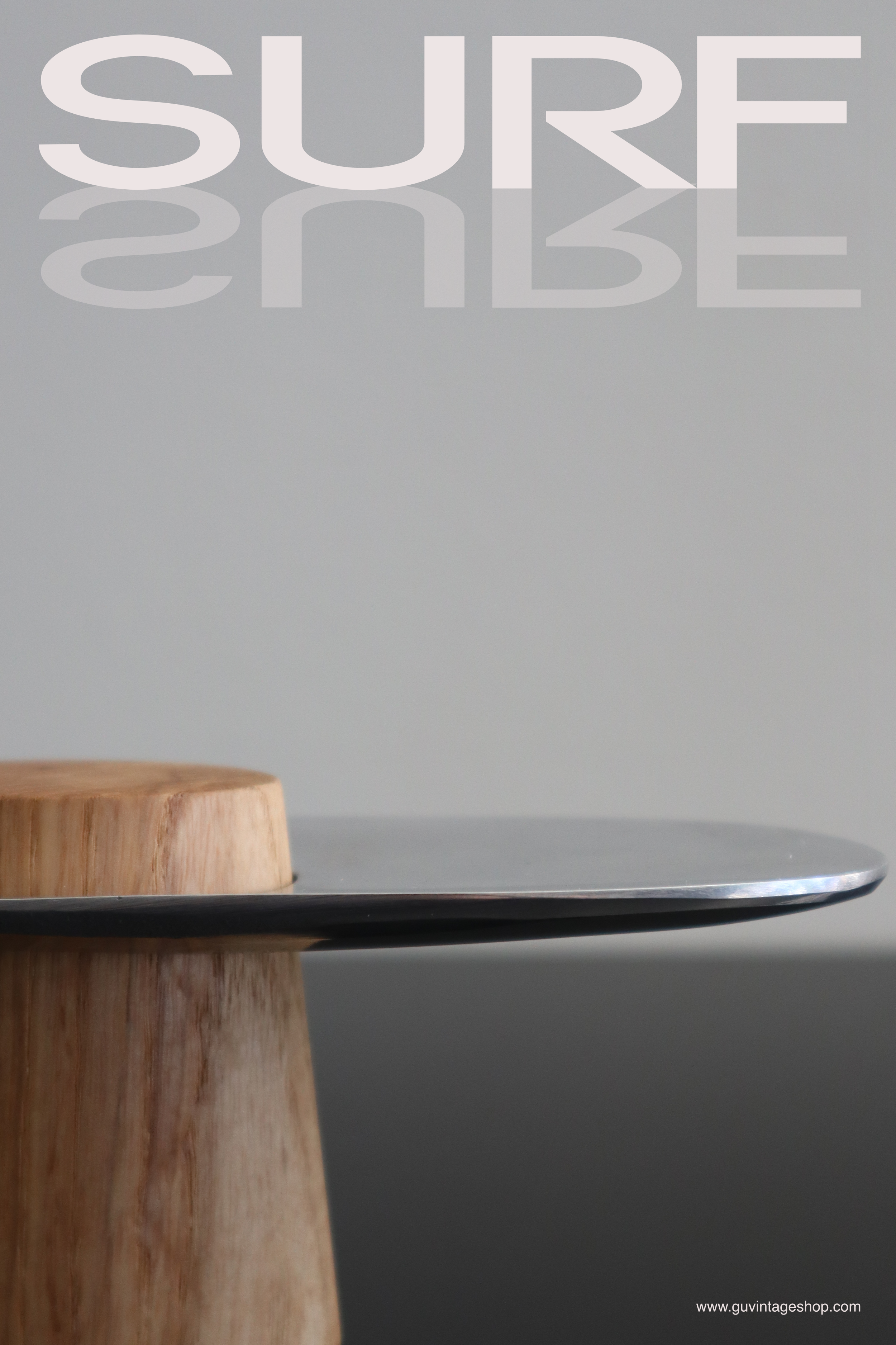

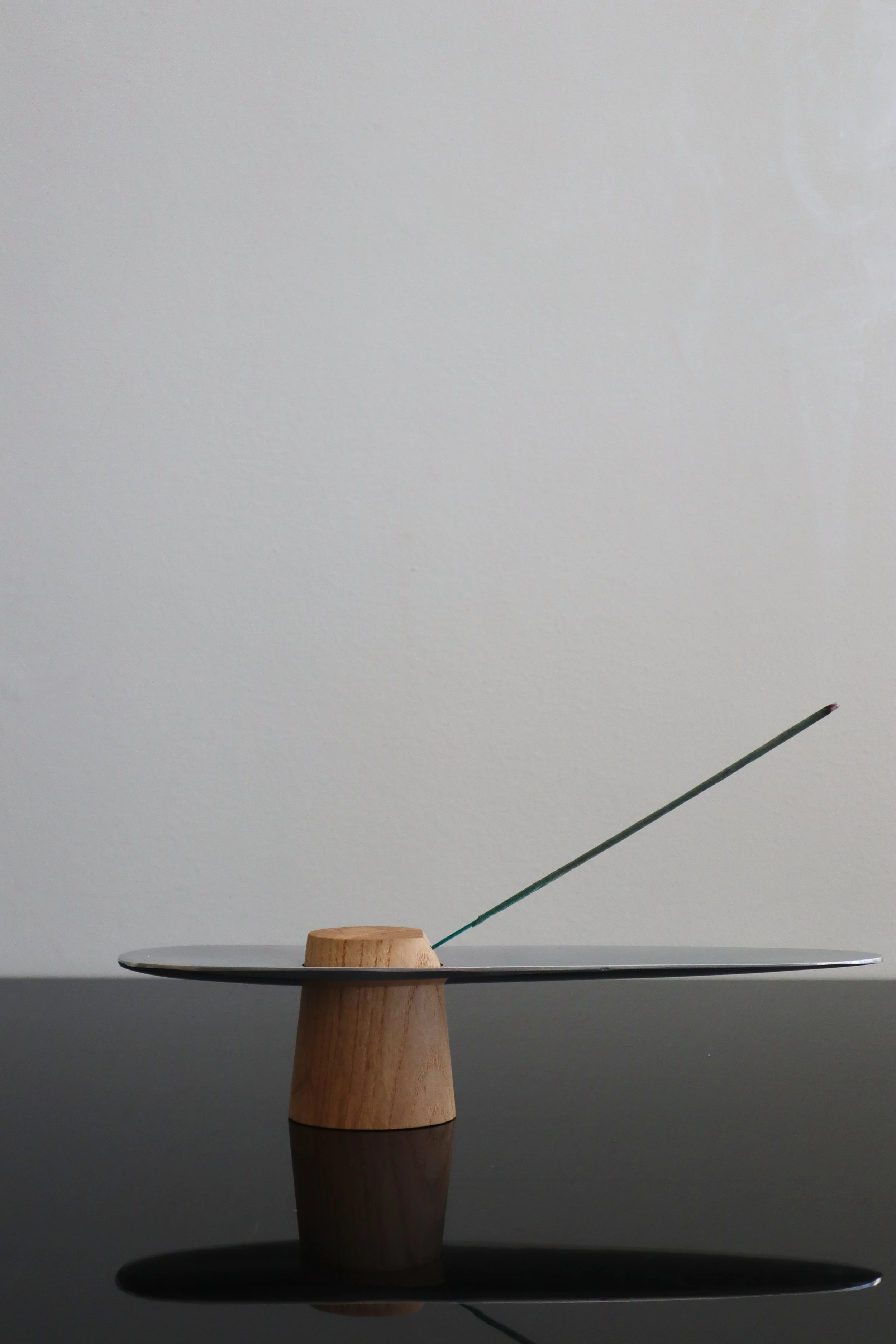
SURF - Incense Holder
Crafted by local artisans in South Korea.
Made of Mirror Polished Aluminum and Ebonized / Ash Wood.
SURF© combines two natural materials, that visually performs harmonic combination. The measured balance and the interlocking method was carefully considered in the design of the piece.
We hope you appreciate it.
Design References



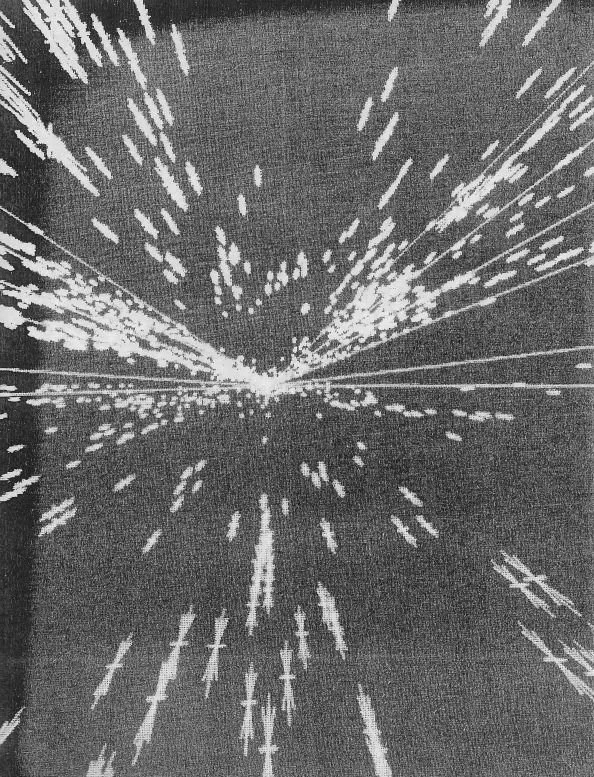

SIIIIIIIIILVER SURFER
// drops 11/18/26 //
SIIIIIIIIILVER SURFER // drops 11/18/26 //
The story of Norrin Radd
Norrin Radd was born on Zenn-La, a technologically advanced planet whose inhabitants had largely eliminated war, poverty, disease, and material suffering.
But Norrin was dissatisfied.
While most of his civilization enjoyed its comfortable existence, Norrin felt that something essential had been lost. His people had become complacent, abandoning exploration, curiosity, and the desire to discover the universe.
He dreamed of traveling beyond his planet and exploring the cosmos.
He was also deeply in love with a woman named Shalla-Bal.
Then everything changed.
I. The Arrival of Galactus
One day, Galactus appeared above Zenn-La.
Galactus was a cosmic entity who survived by consuming the energy of entire planets. His arrival meant the destruction of Norrin's civilization.
Realizing that his people could not defeat Galactus, Norrin approached him with a proposal.
He would become Galactus's servant and search the universe for planets the cosmic entity could consume, provided Galactus spared Zenn-La.
Galactus agreed.
He transformed Norrin into a silver-skinned being, granting him extraordinary cosmic abilities and a board capable of traveling faster than light.
Norrin Radd became the Silver Surfer.
His home planet survived, but he was forced to leave Shalla-Bal and everything he knew behind.
II. The Servant
For years, the Silver Surfer traveled across the universe as the herald of Galactus.
His job was simple: locate planets suitable for his master's consumption.
But this created the central moral contradiction of his existence.
Norrin had sacrificed himself to save one civilization, only to become an instrument in the destruction of others.
Although he had originally acted out of compassion, his service to Galactus increasingly separated him from the moral principles that had motivated his sacrifice.
In the classic story, his transformation and service also suppressed aspects of his former personality and emotional life.
III. His arrival on Earth
Eventually, Norrin discovered Earth.
He signaled Galactus that the planet was suitable for consumption.
But while on Earth, he encountered the Fantastic Four and, most importantly, Alicia Masters, a blind sculptor.
Alicia challenged his understanding of humanity.
Despite the violence, selfishness, and imperfections of human beings, she demonstrated something he had nearly forgotten: compassion.
Norrin began to question his master.
He realized that the inhabitants of Earth possessed an intrinsic value that could not be reduced to their usefulness to Galactus.
He ultimately rebelled, joining the Fantastic Four to prevent Earth's destruction.
Galactus agreed to spare Earth, but punished Norrin by erecting an invisible barrier that prevented him from leaving the planet.
The being who had dreamed of exploring the entire universe became a prisoner of Earth.
IV. A lonely existence
Much of the Silver Surfer's subsequent history concerns his exile and his attempts to understand human civilization.
Norrin finds humanity both admirable and horrifying.
He is fascinated by human creativity, love, loyalty, and generosity.
But he is equally disturbed by war, prejudice, greed, and the willingness of human beings to harm one another.
He repeatedly protects people who fear, misunderstand, or attack him.
He also suffers from his separation from Shalla-Bal, knowing that his choice to save Zenn-La has cost him the possibility of an ordinary life with her.
In later comics, he eventually escapes his confinement and returns to traveling the cosmos. His story expands into encounters with cosmic beings, other civilizations, and the continuing consequences of his relationship with Galactus.
V. The Philosophy behind Norrin Radd
What makes the Silver Surfer especially interesting is that he embodies several conflicting philosophical positions.
Utilitarianism: Was sacrificing other worlds to save his own morally justified?
Existentialism: Can he reclaim his freedom and define himself after serving Galactus?
Moral Responsibility: How responsible is he for destruction committed under an agreement made to save his people?
Alienation: Why does he feel isolated even among the civilization he protects?
Redemption: Can subsequent acts of goodness compensate for past wrongdoing?
There is also a particularly interesting irony in his origin.
Before Galactus arrived, Norrin was dissatisfied with the comfortable, predictable existence of his civilization. He wanted freedom and exploration.
Galactus gave him precisely that: the ability to travel across the universe.
But in exchange, Norrin surrendered his moral autonomy.
He acquired nearly unlimited physical freedom while losing his freedom to choose.
And when he finally exercised that moral freedom by refusing to serve Galactus, he lost his ability to travel through space.
That reversal is arguably the foundation of the character's tragedy.
VI. Recommended Reading
The Silver Surfer #1 (1968)
Written by Stan Lee and illustrated by John Buscema. This is the essential introduction to Norrin Radd's origin, his sacrifice, and his philosophical character.
Fantastic Four #48–50 (1966)
The original Galactus Trilogy by Stan Lee and Jack Kirby, which introduces the Silver Surfer and depicts his rebellion against Galactus.
Silver Surfer: Requiem (2007)
Written by J. Michael Straczynski and illustrated by Esad Ribić. A separate, non-main-continuity story exploring Norrin's mortality, legacy, and the meaning of existence.
VII. The Central Tragedy
What distinguishes Norrin Radd from many other superheroes is that his defining heroic act is not acquiring power, defeating an enemy, or saving his own civilization.
It is recognizing that his original sacrifice did not absolve him of responsibility for what he subsequently helped destroy.
His heroism begins when he decides that obedience is no longer morally acceptable.